Wednesday, January 4, 2012

Twins or Not? - You decide!

Twins are born five years apart...Press Association 
Really?

What do you think of this recently posted story I found on our friends, Pregnant.or.Parent.of.Twins 'Facebook Page  
Original article from http://uk.news.yahoo.com/twins-were-born-5-years-apart-091401105.html


Seven-week old Floren Blake was born five years after her 
twin brother Reuben
A mother has spoken of her joy after giving birth to a much longed-for "twin" to her five-year-old son.

Reuben and Floren Blake were conceived from the same batch of embryos but were born five years apart after some embryos were frozen during fertility treatment.

Parents Simon, 45, and Jody, 38, had been trying to start a family without success and began treatment in 2005. Five embryos were created and two implanted in Mrs Blake, which resulted in the birth of Reuben on December 9, 2006.

The remaining three embryos were frozen until the couple, from Cheltenham, Gloucestershire, decided to try for another child last year...

SO ARE THEY TWINS?  We don't think so but what do you think?


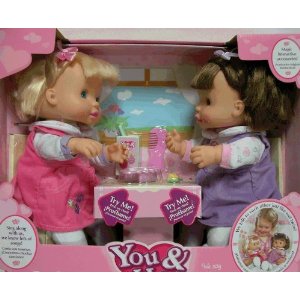
Wordless Wednesday - Twins in Toyland


 Do your twins love toys that are Twin-Themed? 

The Twin-Buzz: World News about Multiples

Seeing double? Number of twins in U.S. spikes   By Linda Carroll

Our friends at Stuff4Multiples just shared this great story from http://vitals.msnbc.msn.com on their facebook page.
INTERESTING NEW STATISTICS ON TWINS.

With these twins, fame comes in a double helping.
The number of twins born to American women has risen dramatically over the past three decades, a new government study shows.
Twin birth rate rose 76 percent from 1980 through 2009, according to report from the Centers of Disease Control and Prevention that was released Wednesday. While 189 out of every 10,000 births was a twin delivery in 1980, in 2009...

365 Days of Twinipedia - Day 17


Day Seventeen of Twinipedia: 


Fact #17
Looking to Conceive twins or multiples?
This is a really interesting fact.  Did you know that there are fewer twin conceptions in the month of January, while there are more in the month of July?

Why?

Researchers and scientists are not totally sure why this is the case but some believe that woman may have higher FSH (Follicle Stimulating Hormone) levels in July than in January.  They think this might be because there are longer daylight hours in the month of July and that this additional daylight exposure may have an effective on increased FSH levels in women which can increase egg production in that time frame.  

WHO KNEW!  


So I guess if you are looking to conceive twins, Fraternal twins that is since this scenary is about multiple eggs getting produced and fertilized, not a single egg splitting, July is your month! :):):)


These great facts where found at:

Tuesday, January 3, 2012

MSNBC.com says to check out the wonderful winter meteor show tonight in N.East

Quadrantid meteor shower should be a great show to see tonight.   
MSNBC.com

"...Promising viewing prospects According to Robert Lunsford of the American Meteor Society, maximum activity this year is expected on Wednesday morning (Jan. 4) at 2:30 a.m. ET.
For those in the eastern United States, the radiant — that point in the sky from where the meteors will appear to emanate from — will be about one-third of the way up in the east-northeast sky. The farther to the north and east you go, the higher in the sky the radiant will be. To the south and west, the radiant will be lower, and the meteors will be fewer. 
Although the moon will be at a bright waxing gibbous phase, it will set by 3 a.m., leaving the sky dark for prospective meteor watchers until the first light of dawn appears at around 6 a.m.
Quadrantid meteors are described as bright and bluish with long silvery trains. Some years produce a mere handful, but for favorably placed observers, this could be a shower to remember; at greatest activity, according to Lunsford, "Eastern observers may be able to see 60-75 Quadrantids per hour." ..."

To read more and find out more viewing details - go to http://www.msnbc.msn.com/id/45857264/ns/technology_and_science-space/

Great video from ONE.org 's FB page reflecting on years-past.


"VIDEO: A look back at ONE through the years. Thanks to our members' actions, we have made a real difference in the lives of the poorest people on the planet.

Thank you for all that you do, and here's to an amazing 2012!


www.youtube.com
Time and again ONE Members have been on the front lines in the fight against extreme poverty and preventable disease. Your actions have made a real differenc..."

Check out what One.org is going to be up to in 2012.

The Twin-Buzz: World News about Multiples

Twin study revealed secrets to looking younger

Sun, smoking, alcohol and stress can all add years to your face


By Joan Kron    

For years, the similarities between Jeanne and Susan were uncanny. Growing up, the identical twin sisters not only were mirror images of each other, but also shared a bunch of preferences and personality quirks. Even now, living 1,000 miles apart —...

To Read More, go to http://www.msnbc.msn.com/id/33385839/ns/health-skin_and_beauty/t/twin-study-reveals-secrets-looking-younger/#.TwLtjdRWrjs


To Check out past Twin-Buzz Articles and Posts, go to our Twin-Buzz Page on our website.
  1. to Jeanne and Susan

    Age: 61

    Jeanne (left) is the twin who commented that her sister looks “ten years older” — in fact, the researchers upped that to an 11-and-a-quarter-year edge. The reasons for Susan’s condition are that she smoked for 16 years of her life, sunbathes, and weighs 15 pounds less. Since her 20s, Susan (right) has spent as much time as she could in the sun (she has plenty of opportunity on Florida’s east coast, where she moved more than a decade ago). Jeanne, meanwhile, has aimed for “as little exposure as possible.” Besides causing Susan’s dark, patchy discoloration and age spots, UV light also reduces skin’s elasticity, increasing wrinkles and deepening creases, Guyuron says. (Department of Plastic Surgery, University Hospitals Case Medical Center) 

365 Days of Twinipedia - Day 16


Day Sixteen of Twinipedia: 


Fact #16

The rate of identical twinning is much higher in mothers that are older.  


The older you are, the higher your chances of having fraternal twins or higher-order multiples. A 2006 study found that women over 35 produce more follicle stimulating hormone (FSH) than younger women. Ironically, increasing levels of this hormone are a sign of failing ovaries and declining fertility. But FSH is also the hormone that causes an egg to ripen in preparation for ovulation each month, and women with extra FSH may release more than one egg in a single cycle. So while older women are statistically less likely to get pregnant, if they do get pregnant, they're more likely to have twins.


Monday, January 2, 2012

365 Days of Twinipedia - Day 15


Day Fifteen of Twinipedia: 


Fact #15

Are Identical Twins Truly Identical in Every Way?

"There are two main factors that cause identical twins Not to be truly identical: 


1. Identical twins share the same DNA - but do not have identical DNA. When the egg splits into two halves to form identical twins, the DNA may not divide equally between the two cells. The basic concept is similar to when you cut an apple in half, the two halves may not look the same. DNA differences of identical twins revolve around the mitochondrial DNA (DNA that is not located in the nucleus of a cell).  Mitochondrial is DNA passed on to the child by Mom. A fertilized egg will have Mom's mitochondrial DNA, half of Mom's nuclear DNA, and half of Dad's nuclear DNA. When the fertilized egg splits into two, the twins will each have identical nuclear DNA, but not EXACTLY identical mitochondrial DNA. Physical differences in identical twins are contributed, in part, to how much and how similar the mitochondrial DNA each twin inherited from Mom expresses itself.


2. Environmental factors both prenatal (for instance, one twin having more room in the womb, viruses, genetic missteps, Twin-to-Twin Transfusion Syndrome, etc.) and after the babies are born (from something as minor as appetite to illness or accidents). Prenatal developmental differences can mean that one twin didn't quite "finish" a developmental stage that his or her twin did. For instance, an undescended testes is not uncommon in baby boys born early - about 50% of boys are born with an undescended testicle. In boy/boy twins it is not uncommon for one boy to have one or both testicles undescended, while his brother has both descended. It is also not uncommon for one twin to have no physical problems, and his or her twin having a heart or lung defect."


My Great Source of Info.  baby.families.com  http://baby.families.com/blog/ode-to-twins-and-supertwins-28-interesting-facts-about-multiples#

Sunday, January 1, 2012

365 days of Twinipedia - Day 14


Day Fourteen of Twinipedia: 


Fact #14
How do Identical twins happen?


    "Identical (or monozygotic) twins happen when a fertilized egg splits into two separate babies - usually within the first twelve days of Mom's pregnancy. After twelve days, the egg may not split entirely and result in conjoined twins. Some people theorize that the later in the pregnancy the egg splits (between days 8 and 12), the more likely the twins will have similar characteristics since they had the additional time to lay "identical" genetic groundwork.
   As far as scientist can determine, there is no reason why the egg splits - it's a spontaneous and random occurrence. One theory is the egg ovulated by maternally mature women (Moms over 35) is not as flexible as it is in younger moms. When a fertilized egg begins its natural division process in creating a baby, the egg actual 'breaks' (or splits) into two instead of dividing."

My Great Source of Info. - baby.families.com - http://baby.families.com/blog/ode-to-twins-and-supertwins-28-interesting-facts-about-multiples#